INDUSTRIAL GAS CLEANING SYSTEMS
Our solutions for industrial emission control
These technologies efficiently eliminate Volatile Organic Compounds (VOCs) generated during industrial processes, converting them into CO₂ and H₂O. This significantly reduces the environmental impact of production activities while ensuring compliance with the strictest environmental regulations.
Key Benefits
VOC destruction efficiencies above 99%
• Maximum energy efficiency through optimised design, reducing consumption and operating costs
• Regulatory compliance guaranteed, including current legislation (e.g. Spanish Royal Decree RD 117/2003)
• Tailored solutions, adapted to each process, sector, and emission type
• Reliable and long-lasting installations, designed for continuous operation and minimal maintenance
• After-sales service and maintenance, including monitoring programmes and equipment traceability
• Wide applicability across a broad range of pollutants and industries
Garantizamos una instalación segura y conforme a especificaciones, ya sea ejecutando directamente el montaje con medios propios o supervisando técnicamente a contratistas locales.
En ambos casos, aseguramos el cumplimiento de los estándares técnicos y de calidad, coordinamos las pruebas de funcionamiento, ajustamos parámetros clave y formamos al personal para una puesta en marcha eficaz y segura.
Instalación técnica y montaje especializado
Puesta en marcha funcional
Formación operativa
Brindamos acompañamiento técnico permanente tras la puesta en marcha. Nuestro equipo ofrece mantenimiento preventivo y correctivo, diagnóstico de incidencias, asistencia remota, revisiones programadas y optimización continua.
Todos nuestros planes se apoyan en repuestos originales Kalfrisa, garantizando compatibilidad y rendimiento.
Mantenimiento preventivo adaptativo
Mantenimiento correctivo express
Optimización post-instalación
Actualizamos equipos y modernizamos instalaciones mediante retrofit y revamping, sustituyendo componentes obsoletos, mejorando el rendimiento térmico y adaptando los sistemas a nuevas normativas.
Estas intervenciones pueden implicar la renovación parcial o sustancial de la planta, según las necesidades del proyecto.
Revamping térmico, mecánico y estructural
Retrofit tecnológico funcional
Actualización o reacondicionamiento de cámaras, intercambiadores, aislamientos, conducciones, etc
Mejora de eficiencia y reducción de emisiones
Transformamos instalaciones tradicionales mediante soluciones inteligentes y conectividad avanzada.
Implementamos tecnologías de automatización industrial, monitoreo remoto en tiempo real y análisis predictivo de mantenimiento, integrando tu planta al entorno digital de la Industria 4.0 para maximizar eficiencia, productividad y control operativo.
Automatización avanzada de procesos térmicos
Supervisión remota 24/7
Mantenimiento predictivo basado en datos
Evaluamos técnica y normativamente las instalaciones de nuestros clientes, planteamos mejoras y apoyamos en el cumplimiento legal y de sostenibilidad.
Además, como agente descarbonizador industrial, ayudamos a reducir consumos energéticos, emisiones y avanzar hacia una industria más limpia.
Auditorías de eficiencia energética y emisiones
Estudios de viabilidad técnica y económica
Acompañamiento en cumplimiento normativo
Soporte experto en IPPC, BREF, RITE, ISO y normativa medioambiental europea.
Estrategias de descarbonización térmica
Mediciones de emisiones y condiciones de operación
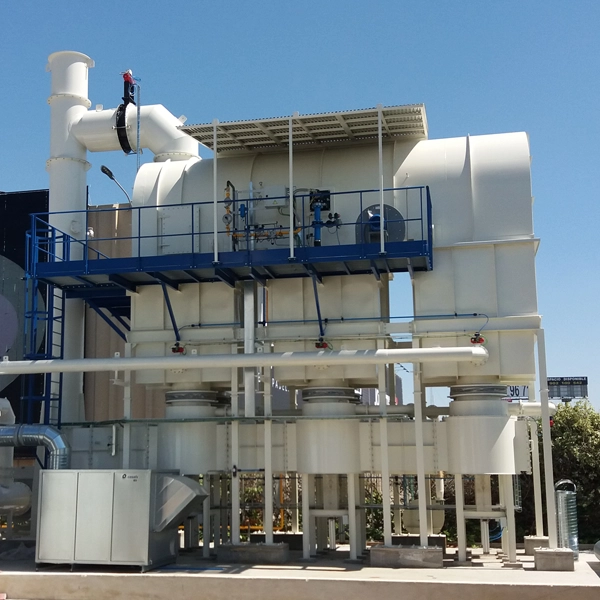
Regenerative Thermal Oxidation
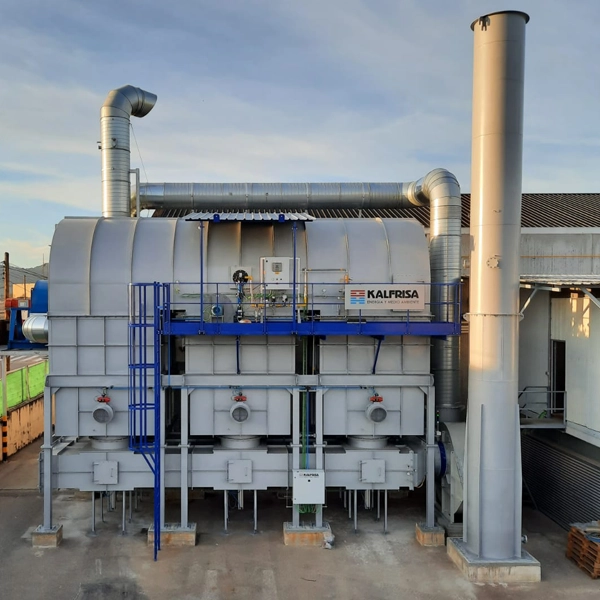
Regenerative Thermal Oxidisers (RTOs) effectively eliminate Volatile Organic Compounds (VOCs) produced in industrial processes, achieving destruction efficiencies over 99% (≤ 20 mgC/Nm³ guaranteed).
Their design offers maximum energy efficiency (>95%) through thermal recovery using ceramic beds, making them ideal for a wide range of VOC concentrations and flow rates.
Additionally, RTOs allow energy recovery in the form of air, hot water, or thermal oil, further improving overall system performance.
Operating Parameters:
• Treated gas flow range: 1,000 – 250,000 Nm³/h
• Auxiliary energy source: Natural gas, LPG, or other fuels
Recuperative Thermal Oxidation
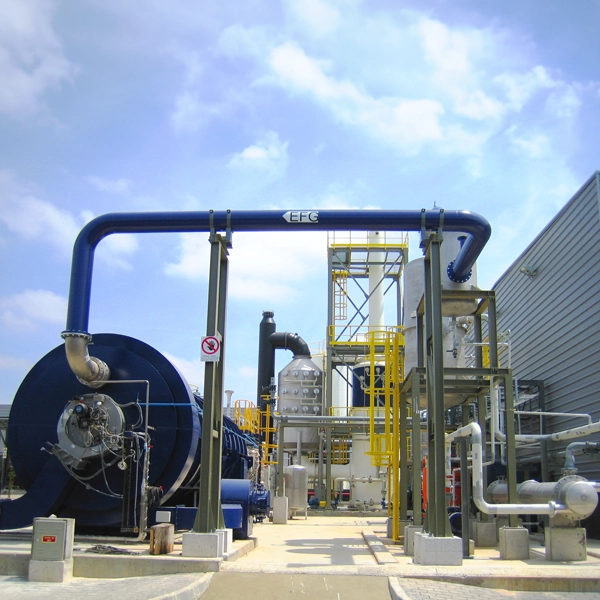
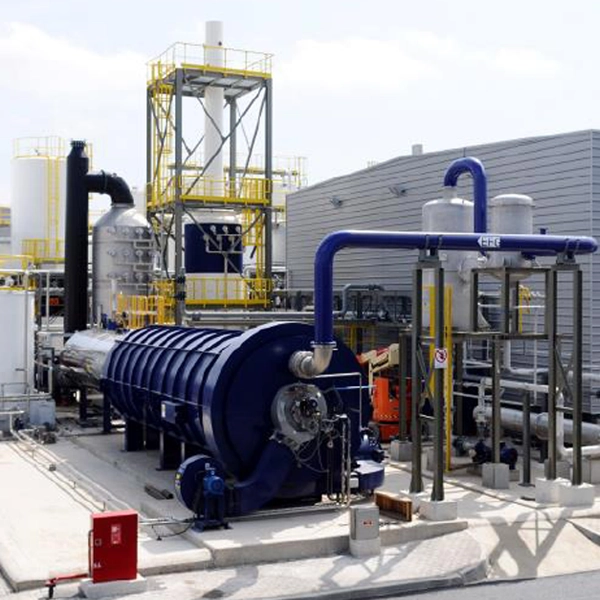
Kalfrisa’s Recuperative Thermal Oxidisers are designed for the destruction of VOCs in industrial emissions through direct oxidation at temperatures of up to 1,500 °C.
These systems convert pollutants into CO₂ and H₂O under tightly controlled conditions, ensuring optimal temperature, residence time, and mixing turbulence.
Their main advantage lies in the high-value heat recovery, which can be harnessed in the form of:
• High-pressure steam
• Thermal oil
• Hot air
Operating Parameters:
• Exhaust gas flow rate: 1,000 – 10,000 Nm³/h
• Air preheating: up to 700 °C
Complementary Systems
In some cases, the gas stream may contain additional pollutants beyond VOCs—such as particulate matter or halogenated compounds—making it necessary to optimise the gas stream conditions before or after the main emission treatment.
To support this, we offer complementary treatment systems, including:
The rotoconcentrator or zeolite wheel is an advanced solution for treating air streams with low concentrations of VOCs and odors, where the emission flow rate is high and dispersed.
Its function is to concentrate the volatile organic compounds (VOCs) present in the contaminated air by means of a zeolite adsorbent rotor, significantly reducing the volume of gas to be treated and, therefore, the energy consumption of the thermal oxidation system (RTO).
This pretreatment makes it possible to clean up to 90% of the airflow and optimize the thermal efficiency and carbon footprint of the process by reducing fuel demand and improving the overall performance of the equipment.
The combination of Zeolite Wheel + RTO thus becomes an ideal solution for industrial decarbonization, especially in applications with large volumes of diluted air, such as waste treatment plants, painting, automotive, or light chemical industries.
In addition, its continuous operation, low maintenance, and high reliability make the zeolite wheel a sustainable, robust, and efficient system for gas emission purification.
A scrubber, or gas washer, is a wet neutralization system that uses a liquid absorbent to remove gaseous contaminants before their release. It is mainly used to treat acidic or basic gases, commonly generated by halogenated VOCs that form acids.
Bag filters are devices that remove solid particles suspended in a gas stream by passing it through a filter fabric. They are used when high filtration efficiency is required, as they can capture submicron particles with up to 99.9% effectiveness.
Dry scrubbing systems are devices that remove acidic gases and contaminants from a gas stream by injecting powdered reagents, producing physicochemical reactions that transform the pollutants into solids, which can then be captured.
An activated carbon filter is an adsorption system that captures contaminants present in a gas stream, which adhere to the surface of the carbon. It is ideal for removing VOCs, odors, sulfur compounds, dioxins, and furans.
Catalogue